500 Casino Payment Methods
Eight ways to put money into a 500 Casino account from Ireland, six that can send it back out, and a couple of quirks that catch people on the first withdrawal. Everything below is in euro.
The short answer
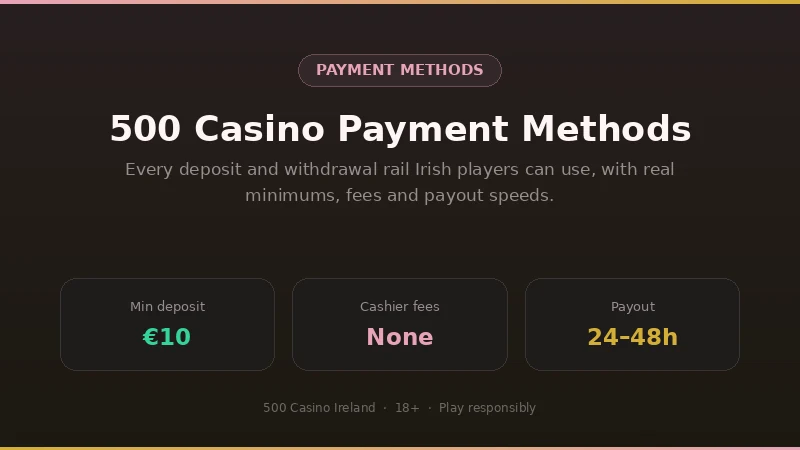
500 Casino takes Visa and Mastercard debit cards, Google Pay, Trustly, Skrill, ecoPayz, SEPA bank transfer and Bitcoin, all in euro. The floor is €10 on cards and Google Pay, €20 on Trustly and wallets, €50 on crypto and €100 on a bank transfer. The cashier charges nothing either way. Withdrawals are processed in 24 to 48 hours, capped at €5,000 a day, and must go back the way the money came in.
Bank rails: Trustly and SEPA transfer
Two of the eight methods move money straight out of your current account with no card in the middle. Trustly is the one most Irish players end up using. You pick your bank from a list, approve the payment in your own banking app, and the balance shows up in the cashier before you have closed the tab. Minimum €20, maximum €5,000 a go, nothing added at either end.
Trustly matters here for a reason that has nothing to do with speed. It is one of the few methods on this list that works in both directions, so if you fund with it you can also be paid out with it, and the return trip does not need a separate verification step. Since Ulster Bank and KBC left the Irish retail market, most people have moved to AIB, Bank of Ireland, Permanent TSB, Revolut or N26, and all of those appear in the Trustly bank picker.
The plain SEPA bank transfer is the other rail, and it is the one to use for large amounts rather than routine ones. €100 minimum, €20,000 maximum, one to three working days in. It is free, it never gets blocked by a card issuer, and it is the fallback the casino uses when a payout cannot go back the way it arrived. The trade-off is obvious: you are waiting on a bank rather than on a cashier.
A SEPA transfer initiated on a Friday afternoon is normally credited on the Monday or Tuesday. Bank holidays count as non-working days on both sides, so the Irish August and October holidays add a day that neither the casino nor your bank will warn you about.
Debit cards, Revolut and Google Pay
A Visa or Mastercard debit card is still the default. €10 in, instant, free, and it is the method most people start on. Worth knowing before you type an amount: €10 opens the cashier, but the welcome offer only triggers from €20. Google Pay sits on top of the same card, which is why its minimum is also €10 — the only real difference is that the card number never leaves your phone, so a leaked cashier is a smaller problem for you.
Revolut is not listed as its own method and it does not need to be. A Revolut card is a debit card on one of the two networks, and the cashier processes it as one. What does need attention is the gambling block. Revolut ships a toggle under Security that blocks gambling merchants outright, and when it is on every attempt fails at the issuer, so the cashier can only tell you the payment was declined. It is not a cooling-off period you can talk your way past either: switching it off takes effect after a delay by design.
AIB, Bank of Ireland and Permanent TSB all offer something similar in their apps under card controls. If a card has worked for months and then stops for no visible reason, the block is the first thing to check, ahead of anything at the casino end. An Post Money and N26 debit cards behave like any other card on the network. Credit union debit cards are patchier: a credit union current account card is a normal Mastercard or Visa debit, but plenty of unions apply their own gambling restrictions on top.
Credit cards are a different conversation, and a short one. Irish issuers commonly price a gambling transaction as a cash advance, which means interest accruing from the day of the transaction and a fee for the privilege, with no interest-free window. On top of that, the Gambling Regulation Act 2024 contains a prohibition on licensees accepting credit card payments for gambling; its provisions are being commenced in stages by the Gambling Regulatory Authority of Ireland rather than all at once. Either way, there is no version of this where a credit card is the sensible choice.
Wallets and Bitcoin
Skrill and ecoPayz both start at €20 and stretch to €10,000 a transaction. Their real advantage is on the way out rather than the way in: a wallet payout is credited the same day the casino releases it, while a card refund still has to crawl back through the network. If you cash out more than occasionally, funding with a wallet in the first place is the difference between hours and days.
The catch is that a wallet adds a second account to keep verified, and Skrill in particular applies its own fees on the leg between the wallet and your bank. Those are Skrill's charges, not the casino's, and they are easy to miss because the cashier quite correctly reports a fee of zero.
Bitcoin sits at the far end: €50 minimum, €50,000 maximum, ten to fifteen minutes to confirm. The number the cashier shows you is a euro conversion at the rate at the moment of deposit, so a slow confirmation and a moving market can land a different figure than the one you agreed to. There is a network fee on the way out that no one on either side controls. It is a fine method if you already hold crypto and a poor reason to start.
Every method, side by side
Minimums and ceilings are per transaction. The withdrawal column is the one people skip and then regret: four of these eight rails cannot pay you back at all, and on those the money returns by bank transfer instead.
| Method | Min | Max | Deposit speed | Cashier fee | Pays out? |
|---|---|---|---|---|---|
| Visa debit | €10 | €5,000 | Instant | Free | Yes, 1–3 days |
| Mastercard debit | €10 | €5,000 | Instant | Free | Yes, 1–3 days |
| Google Pay | €10 | €2,000 | Instant | Free | No — pays to bank |
| Trustly | €20 | €5,000 | Instant | Free | Yes, 1–2 days |
| Skrill | €20 | €10,000 | Instant | Free | Yes, same day |
| ecoPayz | €20 | €10,000 | Instant | Free | Yes, same day |
| SEPA bank transfer | €100 | €20,000 | 1–3 days | Free | Yes, 1–2 days |
| Bitcoin | €50 | €50,000 | 10–15 min | Free | Yes, network fee |
Daily payout ceiling across all methods: €5,000. A larger balance is released in instalments on consecutive days rather than refused.
Why a deposit gets declined
Almost every decline happens at your bank, not at the cashier, which is why the error message is so useless. The cashier is told no and passed no reason. Here is what is actually behind it, roughly in order of frequency.
1. Merchant category 7995 is blocked
Gambling transactions carry their own category code and Irish banks let you block it, sometimes by default on younger or student accounts. Look for a gambling toggle under card controls or security in your banking app.
2. It was a credit card, not a debit card
Easy to do when both cards live in the same wallet app. Check the card art rather than the number: a debit card says debit on the face.
3. The name does not match
The cardholder name has to match the account holder name. Third-party payments are refused as a matter of anti-money-laundering policy, and a joint account card in a spouse's name counts as third party.
4. 3-D Secure never got approved
The push notification arrives while you are still looking at the cashier, and it expires quietly. If the deposit page sat there spinning, this is usually why.
5. A daily card limit or a fresh card
Contactless and online limits are separate numbers, and a newly issued replacement card often needs one chip-and-PIN transaction in the real world before online payments are enabled.
In none of those cases has money left your account. If you see a pending debit anyway, it is an authorisation hold and it falls off by itself, usually within three to five working days. Retrying the same card four times in a row is the one thing guaranteed to make it worse, because a run of failures is exactly what a fraud engine is built to notice.
What it looks like on your statement
A card deposit appears as an ordinary card purchase: an abbreviated merchant string, often the payment processor rather than the brand, followed by a city that may have nothing to do with where anyone involved is sitting. A Trustly or SEPA payment shows as an outgoing transfer naming the processor. None of them reliably contain the word casino.
That cuts both ways. It means a shared statement does not announce anything, and it also means you cannot audit your own spending from the statement alone. If you want a straight number, take it from the cashier history, where every deposit and withdrawal is listed with a timestamp. Anyone reviewing your account for a mortgage application reads the pattern of transfers, not the descriptor, so treating the descriptor as camouflage is a mistake.
A refunded deposit comes back with the original date attached in some banking apps and today's date in others, which is why a reversal sometimes appears to be missing. Sort by amount rather than by date when you go looking for it.
Five mistakes that cost people time
Leaving verification until the first withdrawal
Documents can be uploaded the day you open the account. Doing it then costs you ten minutes; doing it while a payout sits pending costs you the weekend.
Depositing €5 to test the cashier
It fails below the €10 floor and reads like a broken card. Test with the minimum, not below it — and if you want the welcome offer, the first deposit has to be €20 or more.
Funding on a card and expecting a wallet payout
The return trip has to retrace the deposit up to the amount you paid in. Choose the rail you want to be paid on before you fund, not after you win.
Cancelling a pending withdrawal
The button that puts the money back in your balance is right beside the one that does nothing. Reversing a payout restarts the 24 to 48 hour clock from zero.
Withdrawing while a bonus is still live
Cashing out with wagering unfinished forfeits the bonus balance and, on most terms, whatever it produced. Clear it or drop it deliberately — see why bonuses here are limited for what the terms can and cannot say under Irish rules.
What changed: then vs now
| Then | Now | Why it matters |
|---|---|---|
| Ulster Bank and KBC cards in the bank picker | Both banks gone from the Irish retail market | Old cards and IBANs on file are dead; update the payout account before you need it |
| Credit cards accepted like any other card | Priced as a cash advance, and prohibited under the Gambling Regulation Act 2024 as its provisions commence | A method you should stop planning around entirely |
| Card entry typed into the cashier | Google Pay and in-app approval on the same card | Same money, same speed, one fewer place your card number is stored |
| Verification triggered by the first payout | Documents accepted from day one | The single biggest cause of a slow first withdrawal, and it is avoidable |
Payment questions
What payment methods does 500 Casino accept in Ireland?
Visa and Mastercard debit cards, Google Pay, Trustly open banking, Skrill and ecoPayz wallets, SEPA bank transfer and Bitcoin. Card and Google Pay deposits start at €10, Trustly and wallets at €20, bank transfer at €100 and crypto at €50. Everything is priced and settled in euro.
What is the minimum deposit at 500 Casino?
€10 on a Visa or Mastercard debit card and on Google Pay. Trustly and the wallets start at €20, Bitcoin at €50 and a SEPA bank transfer at €100. Note that the cashier minimum and the bonus minimum are different numbers: the welcome offer needs a first deposit of €20 or more.
Does 500 Casino charge fees on deposits or withdrawals?
The cashier adds nothing at either end. Costs that can still reach you come from outside it: the network fee on a Bitcoin withdrawal, a card issuer that prices a gambling transaction as a cash advance, and the occasional non-euro conversion if you fund from a sterling or dollar account.
How long do 500 Casino withdrawals take?
The stated processing window is 24 to 48 hours, and that clock starts when the payout leaves pending, not when you press the button. After the casino releases it, a wallet lands the same day, a debit card refund takes one to three working days and a SEPA transfer one to two. First withdrawals are slower because verification runs first.
Why was my 500 Casino deposit declined?
In order of how often it happens: your bank blocked merchant category 7995, you used a credit card rather than a debit card, the cardholder name does not match the account name, you dismissed the 3-D Secure prompt in your banking app, or you have a gambling block switched on in Revolut or your bank app. In every one of those cases the money never left your account.
Can I use Revolut at 500 Casino?
Yes, through the card rails rather than as a named method. A Revolut card is a Visa or Mastercard debit card and the cashier treats it as one. The thing to check first is the gambling toggle in Security in the Revolut app: if it is on, every attempt fails at the issuer and the cashier only shows you a generic decline.
Can I use a credit card at 500 Casino?
You should not plan around it. Irish issuers commonly treat a gambling transaction as a cash advance, which means interest from day one and a fee on top, and the Gambling Regulation Act 2024 contains a prohibition on accepting credit card payments for gambling that is being commenced in stages. Use a debit card on the same network instead.
Do I have to withdraw to the same method I deposited with?
Yes, wherever the rail can receive money, and up to the amount you put in. That is an anti-money-laundering rule rather than a house preference. Anything above that, or anything paid in on a one-way rail such as Google Pay, is sent by bank transfer to an account in your own name.
How does a 500 Casino deposit appear on my bank statement?
As a card purchase with an abbreviated merchant string and a city, or as an outgoing transfer naming the payment processor. Neither usually contains the word casino. Match the amount and the timestamp against your cashier history rather than trying to read the descriptor.
Is there a withdrawal limit at 500 Casino?
The published ceiling is €5,000 a day. A larger balance is paid in instalments across consecutive days rather than refused, and a win from a progressive jackpot is usually handled under separate terms, so read the payout clause before you assume the daily cap applies to it.
Ready to fund your account?
€10 on a debit card, €20 on Trustly, and nothing added by the cashier at either end. The welcome offer starts at a €20 first deposit.