Bookies in Dublin
Who licenses the shop on the corner, what the 2% duty is really doing, and what changes for both the counter and your phone as Ireland's new gambling regulator takes over.
The short answer
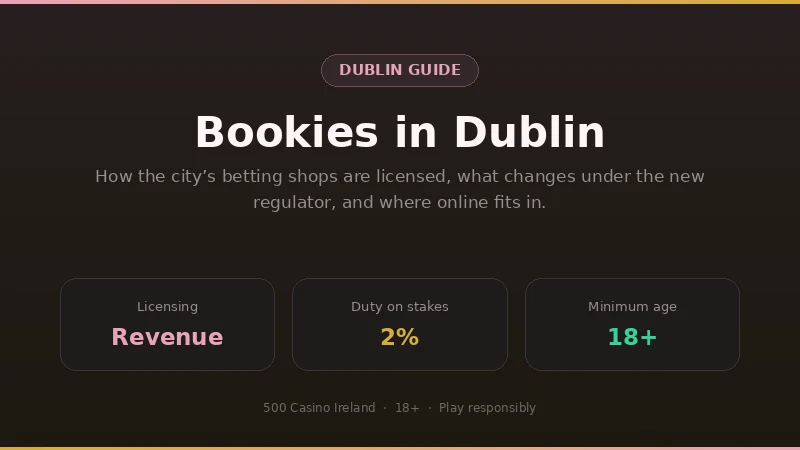
A Dublin bookmaker holds a licence issued by the Revenue Commissioners, backed by a certificate of personal fitness, and registers each shop as a premises. Betting duty is 2% of stakes, paid by the bookmaker rather than taken off your bet. The minimum age is 18. All of that is being handed to the Gambling Regulatory Authority of Ireland under the Gambling Regulation Act 2024, which brings the shop and the app under one regulator for the first time.
What this means if you actually bet
Walk into any betting shop in Dublin — a chain on a main street or an independent on a side road — and the same four things are true. Someone has been vetted as a fit person to hold a bookmaker's licence. The premises itself is registered. Everyone placing a bet is supposed to be over 18 and can be asked to prove it. And the price on the board already accounts for a 2% duty the bookmaker owes on your stake whether the bet wins or loses.
The duty point is worth sitting with, because it is misunderstood in both directions. It is not deducted from your winnings, and it is not a tax you pay. It is a charge on the bookmaker's turnover, which means it is priced into the margin in the odds rather than presented to you as a line item. Since it applies to remote betting as well as retail, an online bookmaker taking bets from Ireland is inside the same regime — one of the few places where the shop and the app have been treated identically for years.
What differs is everything around the transaction. A cash bet in a shop leaves no account trail, gives you no deposit limit, and offers no record beyond the docket in your pocket. An online account cannot be paid out until identity checks are done, keeps a complete history, and comes with limits and time-outs built in. Neither of those is straightforwardly better; they are different trade-offs, and it is worth knowing which one you are choosing.
The rule itself
Retail bookmaking in Ireland runs on the Betting Act 1931, substantially modernised by the Betting (Amendment) Act 2015. The 2015 amendment is the reason the framework covers online betting at all: it brought remote bookmakers and betting intermediaries into the licensing net rather than leaving them outside a law written for a counter and a chalkboard.
Three separate things are required. A certificate of personal fitness, which tests whether the individual behind the business is suitable. A bookmaker's licence from the Revenue Commissioners, renewable and payable. And registration of each premises from which bets are taken, so a chain with fifteen Dublin shops is dealing with fifteen registrations rather than one.
On top of that sits betting duty: 2% of the amount staked for bookmakers, and 25% of commission earned for betting intermediaries such as exchanges. Both are the operator's liability. A bookmaker cannot lawfully pass the duty on to you as a separate deduction at the counter.
All of this is transitional. The Gambling Regulation Act 2024 establishes the Gambling Regulatory Authority of Ireland as the single licensing body for betting, gaming and lotteries, in person and remote. It is being commenced in phases, so for a period the old Revenue-based arrangement and the new regime exist alongside each other.
How it got here, and where it goes
1931 — Betting Act
The framework the trade ran on for the better part of a century: licences, registered premises, permitted hours.
2015 — Betting (Amendment) Act
Remote bookmakers and betting intermediaries brought inside the licensing regime, which is where online betting from Ireland got its legal footing.
2019 — Betting duty doubled
Duty on stakes moved from 1% to 2%, and intermediary commission duty to 25%. Independent shops in particular felt it; some did not survive it.
2024 — Gambling Regulation Act signed
A single statute covering betting, gaming and lotteries, with a new regulator, advertising restrictions, an exclusion register and a Social Impact Fund.
2025 — The Authority stands up
The Gambling Regulatory Authority of Ireland is established and begins building the licensing regime it will run.
Phased from there
Licence categories, advertising rules and the exclusion register commence on their own timetables. Expect the shop and the online account to end up under one set of rules.
The counter versus the app
| Dublin betting shop | Online account | |
|---|---|---|
| Minimum age | 18, ID on request | 18, verified with documents |
| Identity checks | Only where required | Before any payout |
| Record of what you spent | The docket, and your memory | Full timestamped history |
| Deposit limits | None | Built in, and adjustable |
| Self-exclusion | Per operator, in person | Per account, immediate |
| Payment | Cash or debit card | Debit card, Trustly, wallets, transfer |
| Getting paid | Over the counter | 24–48 hours to the same rail |
If you are moving from the shop to an account for the first time, the payout mechanics are the part that catches people out. The money goes back the way it came in, and verification happens before the first withdrawal rather than after. Both are covered in detail on the payment methods page.
What to do with all of this
- Bring photo ID if you look anywhere near the line. Shops are entitled to refuse without it and increasingly do.
- Keep the docket until the bet is settled and paid. It is the only record that exists on a cash bet.
- Do not expect to pay by credit card, in a shop or online. That door is closing by statute and was already expensive to walk through.
- If you want limits on what you spend, an account gives you tools a counter cannot. Set them when you open it, not after a bad week.
- If you need to stop, ask the operator about self-exclusion directly, and watch for the National Gambling Exclusion Register as it comes into operation.
If that did not solve it
A disputed settlement in a shop goes to the operator's own complaints process first, and it is worth being specific: the time, the docket number and the market, not a description of the argument. If that fails, the regulator is the escalation point, and which regulator depends on when the dispute arose given the transition described above.
If the underlying problem is not the bet but the betting, that is a different call to make and a better one. Problem Gambling Ireland and Gamblers Anonymous Ireland both operate here and neither is connected to any operator.
Where this comes from
Everything above is drawn from primary material rather than from other casino pages. If you want to check it yourself, these are the right places to look:
- The Betting Act 1931 and the Betting (Amendment) Act 2015, for licensing and permitted hours
- Revenue Commissioners material on bookmaker's licences, premises registration and betting duty rates
- The Gambling Regulation Act 2024 and the Gambling Regulatory Authority of Ireland's own publications on commencement
Where a commencement date is still moving we give a period rather than a date. A wrong specific date reads as authoritative and is worse than an honest range.
Dublin bookies questions
How are bookies in Dublin licensed?
Under the Betting Act 1931 as amended by the Betting (Amendment) Act 2015. An operator needs a certificate of personal fitness, then a bookmaker's licence issued by the Revenue Commissioners, and every shop must be a registered premises. That structure is being transferred to the Gambling Regulatory Authority of Ireland as the Gambling Regulation Act 2024 is commenced.
What age do you have to be to bet in a Dublin bookies?
Eighteen, the same as online. Shops ask for ID and are entitled to refuse anyone who cannot produce it. Under-18s are not permitted to place a bet or to be on the premises for that purpose.
What is betting duty in Ireland?
Two per cent of the amount staked, paid by the bookmaker rather than deducted from your bet at the counter. Betting intermediaries such as exchanges pay 25% of the commission they earn instead. It applies to remote betting as well as retail, so an online bookmaker taking bets from Ireland is inside the same regime.
What hours can a Dublin bookies open?
Retail betting offices operate within permitted hours fixed in betting legislation, which have historically run from early morning to late evening and have been extended over the years. Individual shops set their own hours inside that window, and a suburban shop often closes well before a city-centre one. Check the shop rather than assuming.
Can I use a credit card in a betting shop?
Cash and debit cards are the practical options. The Gambling Regulation Act 2024 contains a prohibition on accepting credit card payments for gambling, and Irish card issuers already price a gambling transaction as a cash advance, so the answer is no in every direction that matters.
Is betting online in Ireland different from betting in a shop?
The legal framework is converging — the same regulator is taking over both — but the day-to-day differs. Online accounts require identity verification before a payout, keep a full transaction history, and offer deposit limits and self-exclusion tools. A cash bet in a shop is anonymous until you win enough to be asked.
How do I self-exclude from bookies in Dublin?
At present you ask each operator, and the exclusion applies to that operator's shops. The Gambling Regulation Act 2024 provides for a National Gambling Exclusion Register under the new Authority, intended to make one registration reach licensed operators instead of repeating it shop by shop.
Are winnings from a Dublin bookies taxed?
For a recreational punter, no. The duty is levied on the bookmaker's turnover, not on your win, and Ireland does not charge income tax on ordinary gambling winnings. If gambling is genuinely your trade the position is different and is a question for an accountant, not a casino site.